29 Stars on the Main Repo, 6.89M Monthly Downloads: Braintrust (a $80M Series B, third parties say $800M) Wraps an Open-Source Shell Around a Homegrown Rust Database — and Just Flagged Its Own Flagship Proxy as Deprecated
Evidence date: 2026-10-21 (UTC+8)
Scorecard re-score (5 dimensions × 20, graded after evidence collection): Reachability 20 · Verifiability 19 · Uniqueness 17 · Audience relevance 16 · Multi-dimensionality 17 = 89/100 (only ≥60 earns an article; library pre-score 78).
What this site actually does
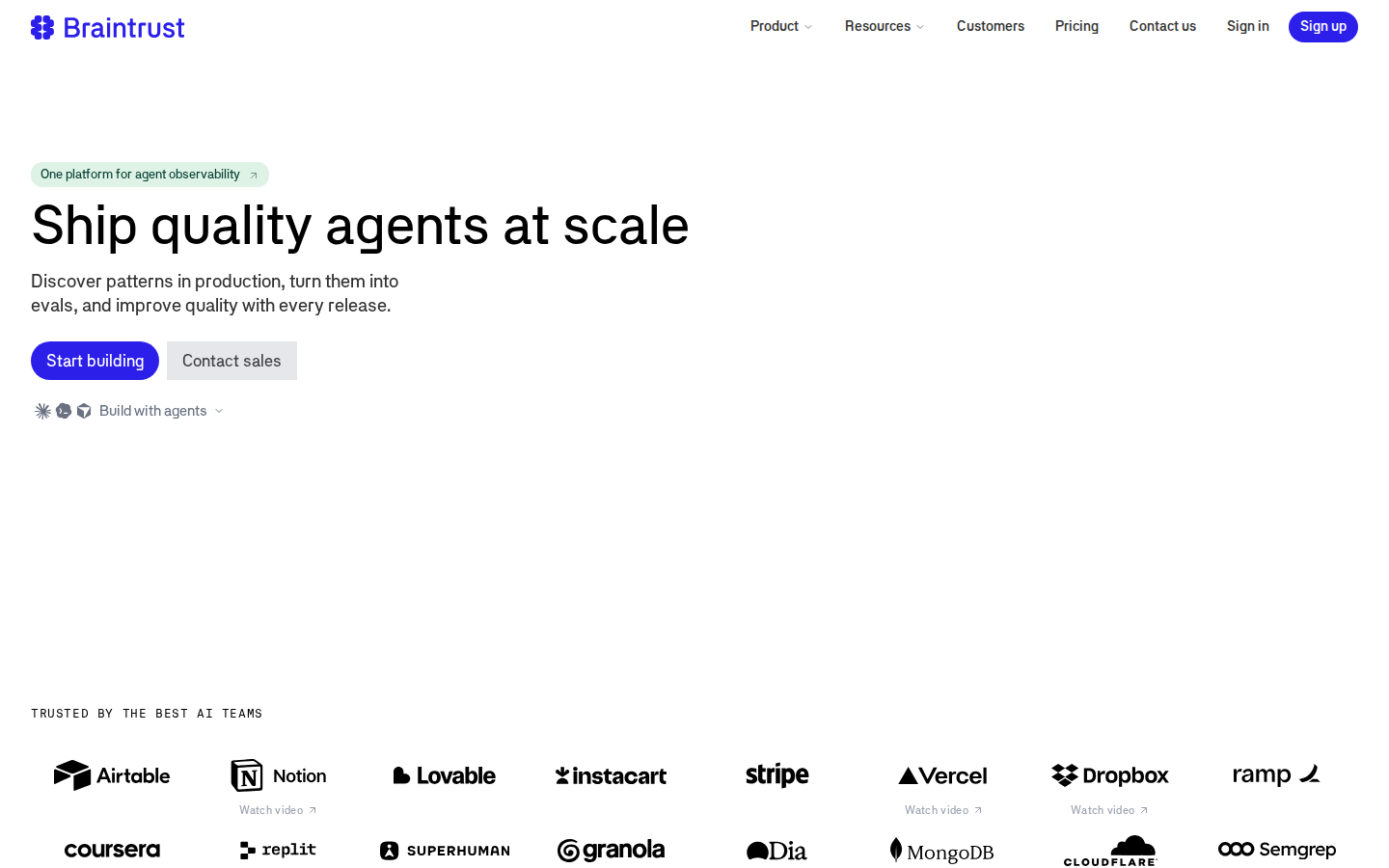
The homepage on evidence day says it in one line: The active observability platform for agents, followed by "Ship quality agents at scale. Discover patterns in production, turn them into evals, and improve quality with every release." — the pitch is not "help you write AI" but keep evidence, score it, and catch regressions in AI that is already running. (Source 1) Fact The product has three pillars — Observe (Trace everything), Evaluate (Test what ships), Discover (Find behaviors) — plus a full education stack: Docs / Blog / Academy / Encyclopedia. (Source 1) Fact
The origin is on record: founded in August 2023 by Ankur Goyal (co-founder of Impira, former head of ML platform at Figma), initially incubated by investor Elad Gil. (Source 7) Fact When TechCrunch covered it on 2023-09-28 it was still a four-person company; Goyal called it an "operating system for engineers building AI software", with a $3M round and investors including Adam D'Angelo and Clem Delangue. (Source 8) Fact Three years later, on 2026-02-25, it ran its first user conference, Trace, at the California Academy of Sciences in San Francisco, at a 500-person scale. (Source 7) Fact
Tech-stack archaeology · outer ring: 108 public repos, 2,365 stars, 45% riding on one eval library
GitHub API grabs on evidence day (full org pagination + search cross-check): the braintrustdata org holds 108 public repos, 78 of them non-fork, with 2,365 stars in total; among non-forks the language spread is Python 22 repos, TypeScript 19, Rust 7, Go 3. (Sources 17/21) Fact The star structure is extremely top-heavy: autoevals alone has 1,063 stars (MIT/Python, created 2023-07-11) — about 45% of the whole org — followed by braintrust-proxy 412, agentbehavior 360, cookbook 62 — and then the main SDK repo, braintrust-sdk-javascript, at just 29 stars. (Sources 18/19/17/20) Fact
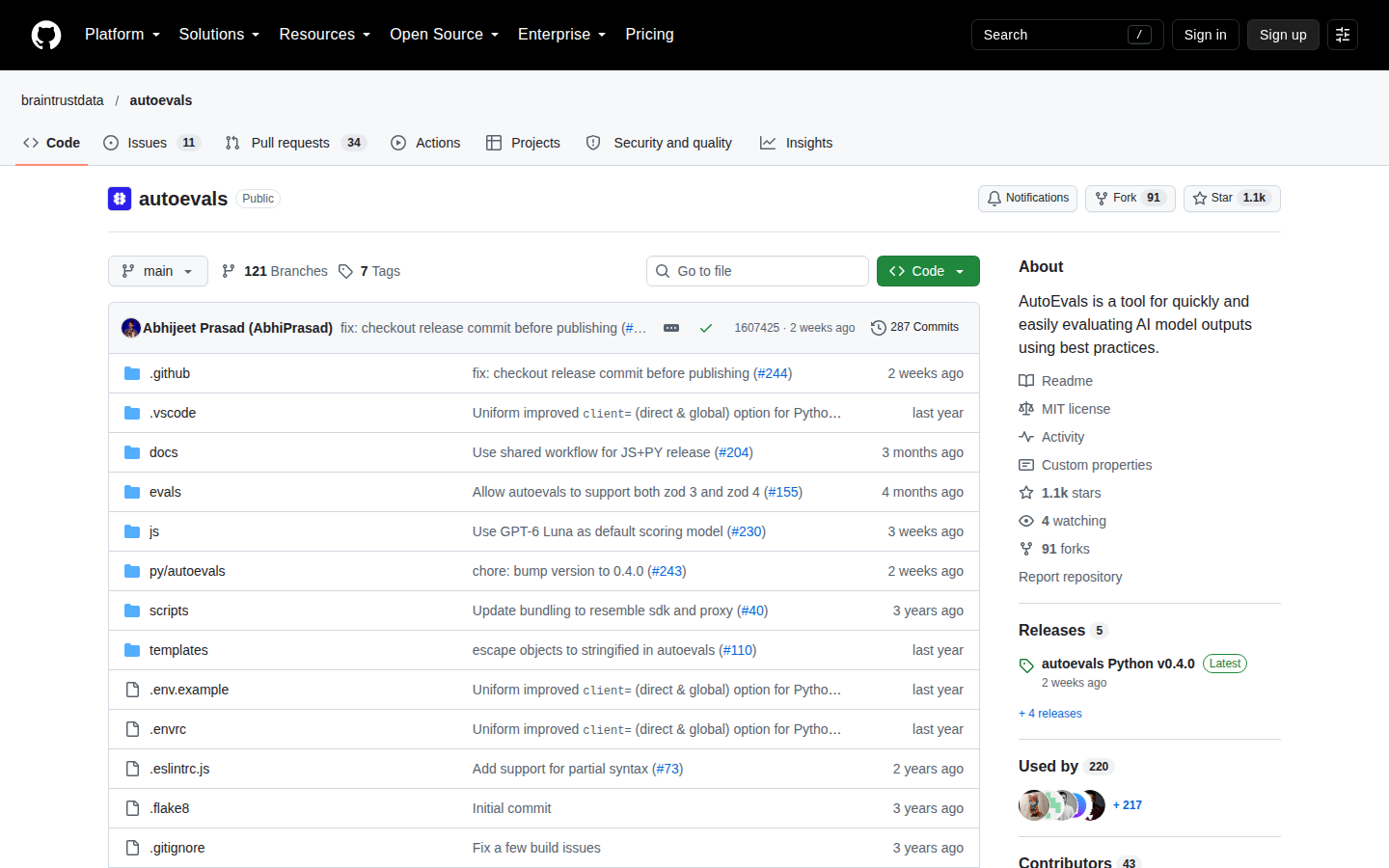
The outer ring is genuinely open source: autoevals and the proxy ship under MIT, the three SDKs under Apache-2.0, plus lingua — a Rust library that "translates between LLM formats" at zero runtime overhead (28 stars, created 2025-08-30). (Sources 18/19/20/38) Fact But lay the 108 repos side by side and everything open sits in the client, evaluator, and format-conversion positions "around" the platform; the platform itself has no repo at all. (Sources 17/21) Inference
Tech-stack archaeology · distribution: 13.46M monthly downloads on npm+PyPI vs 29 stars
This is the most counterintuitive pair of numbers in the piece. The npm package braintrust logged 6,889,964 downloads in the last calendar month (2026-09-19 → 2026-10-18); the PyPI package braintrust shows 6,574,708 monthly and 298,474 per day. (Sources 22/26) Fact Combined, that is roughly 13.46M per month. (Sources 22/26) Inference The curve is steeper still: 385-day npm total 44,242,439, with the monthly series running 2,836,340 (2026-03) → 7,104,136 (2026-09) — 2.5× in six months. (Source 23) Fact
The other half of distribution is autoevals: 2,438,756 npm downloads last month. (Source 24) Fact The package itself is not hidden: npm registry shows braintrust created 2023-07-09 (first release 0.0.1), latest 3.38.0 published 2026-10-19, license MIT, repository pointing at braintrust-sdk-javascript. (Source 25) Fact And that repo has 29 stars; the Python SDK repo has 22. (Sources 20/17) Fact
Inference The downloads come from lockfiles, CI, and corporate mirrors — that is machine behavior; stars are a human tapping a button — that is community behavior. 13.46M against 29 means its distribution does not live in the GitHub community at all, and using "stars" as this company's open-source thermometer misdiagnoses it on sight.
Tech-stack archaeology · core: control-plane/data-plane split plus a homegrown Rust database
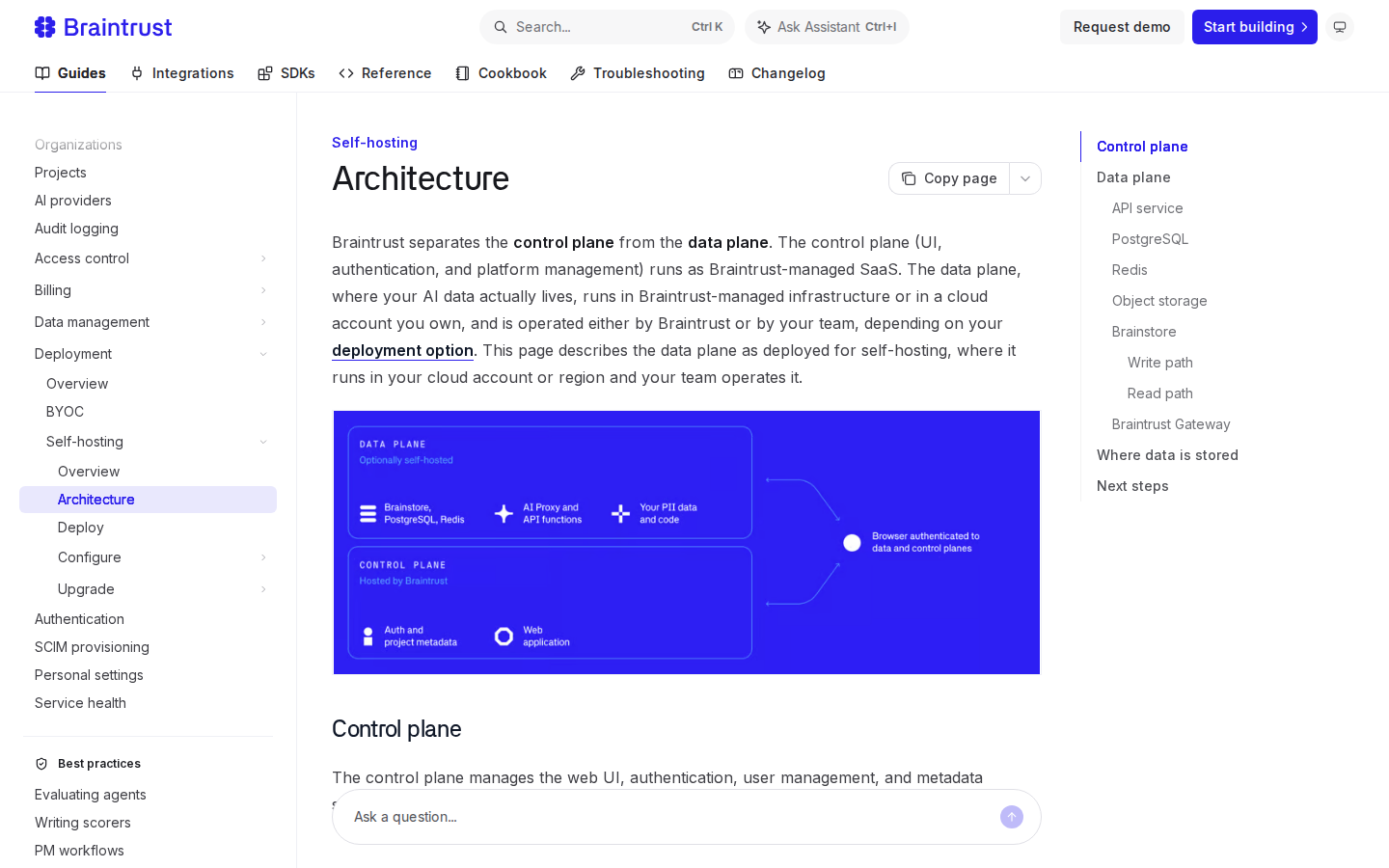
The closed core has two layers. Layer one is the deployment topology: the official architecture page states "Braintrust separates the control plane from the data plane" — the control plane (UI, auth, metadata) runs as Braintrust-managed SaaS, all sensitive AI data lives in the data plane, which can sit in Braintrust-managed infrastructure or your own cloud (BYOC/self-hosted), where the self-hosted data plane is API service, PostgreSQL, Redis, object storage, Brainstore; SDKs send data straight to your data plane. (Source 28) Fact The security page supplies the compliance backing: SOC 2 Type II, HIPAA, GDPR, disclosed through a Trust center. (Source 35) Fact
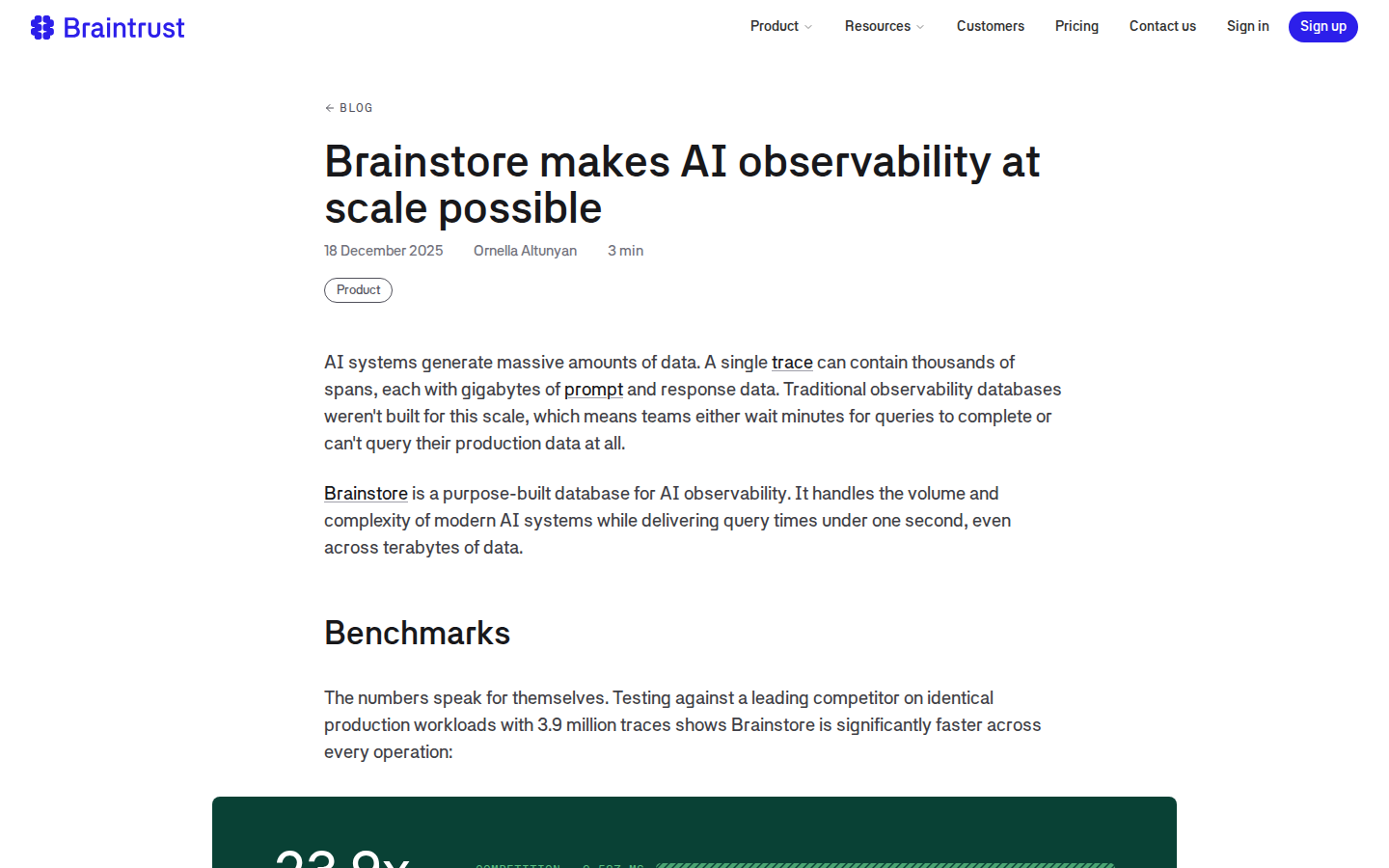
Layer two is the homegrown Brainstore database. The official benchmark self-reports: identical workloads on 3.9M traces against "a leading competitor" — full-text search 23.9× (9,587ms → 401ms), write latency 2.55× (17,775ms → 6,984ms), span load 3.73× (1,290ms → 346ms). (Source 29) Fact — but the competitor is unnamed and the test was run by the party being graded, so these numbers are accepted only on a self-published basis and are flagged doubtful in any comparison context. (Source 29) Doubtful
The product side also leaves traces: the monthly changelog is continuously archived with its navigation reaching back to mid-2023; October 2026 entries ship Patterns severity levels, PagerDuty notifications, coding-agent insights, SQL charts, and Loop (the built-in agent for investigating AI agents) — half the entries require data plane v2.x+, making the version number itself a technological stratum chart for self-hosted customers. (Source 34) Fact On the integration surface, the official page counts All (88) = AI providers 26 + SDK integrations 50 (including 27 agent frameworks, including the Pi Coding Agent SDK) + developer tools 11 + runtime 1, matching a page-by-page audit of llms.txt. (Sources 33/39) Fact
Inference BYOC turns the "data sovereignty concern" into the Enterprise tier's pricing rationale; Brainstore turns "observability data got too big to query" into a technical narrative — the core's two layers each map onto one selling point, and that is product design rather than coincidence.
Archaeological traces: the retirement path of the flagship proxy
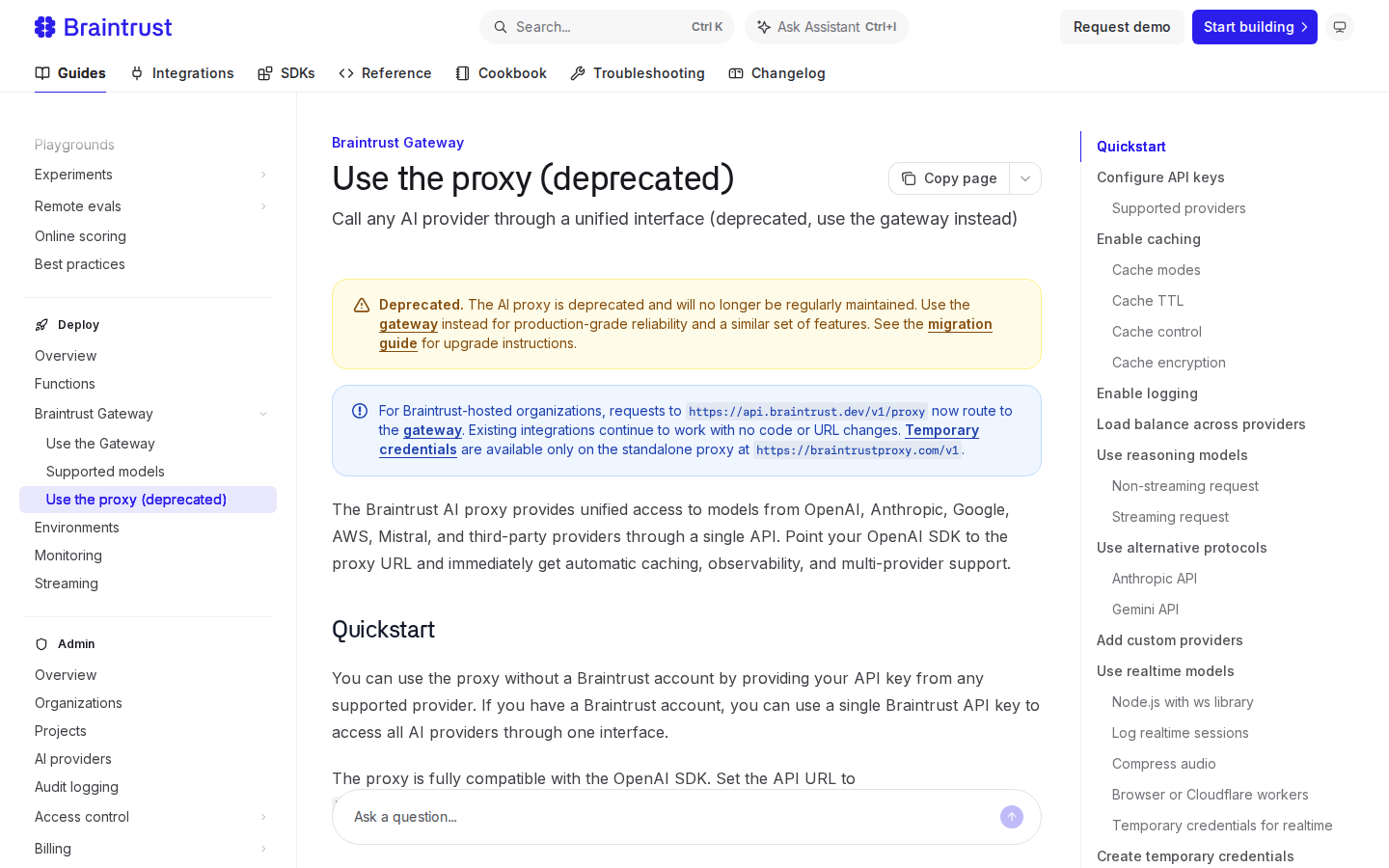
Where tech-stack archaeology earns its keep is in deprecations. The evidence-day doc page 《Use the proxy (deprecated)》 says: "The AI proxy is deprecated and will no longer be regularly maintained. Use the gateway instead…For Braintrust-hosted organizations, requests to https://api.braintrust.dev/v1/proxy now route to the gateway. Existing integrations continue to work with no code or URL changes." (Source 31) Fact — first declare it unmaintained, then silently reroute the traffic to your own gateway, with existing integrations changing not one line. (Source 31) Fact
Parallel accounting: the braintrust-proxy repo was still being pushed on the same day (2026-10-20, 412 stars, MIT), and its README still carries the original promise of "unified API / automatic caching / observability『Coming soon』". (Sources 19/32) Fact Docs say unmaintained while the repo stays live — not a contradiction (security patches and feature maintenance are different things) — but any citation must supply both sentences together. (Sources 19/31) Inference
Money · three price tiers and four capital-round calibers
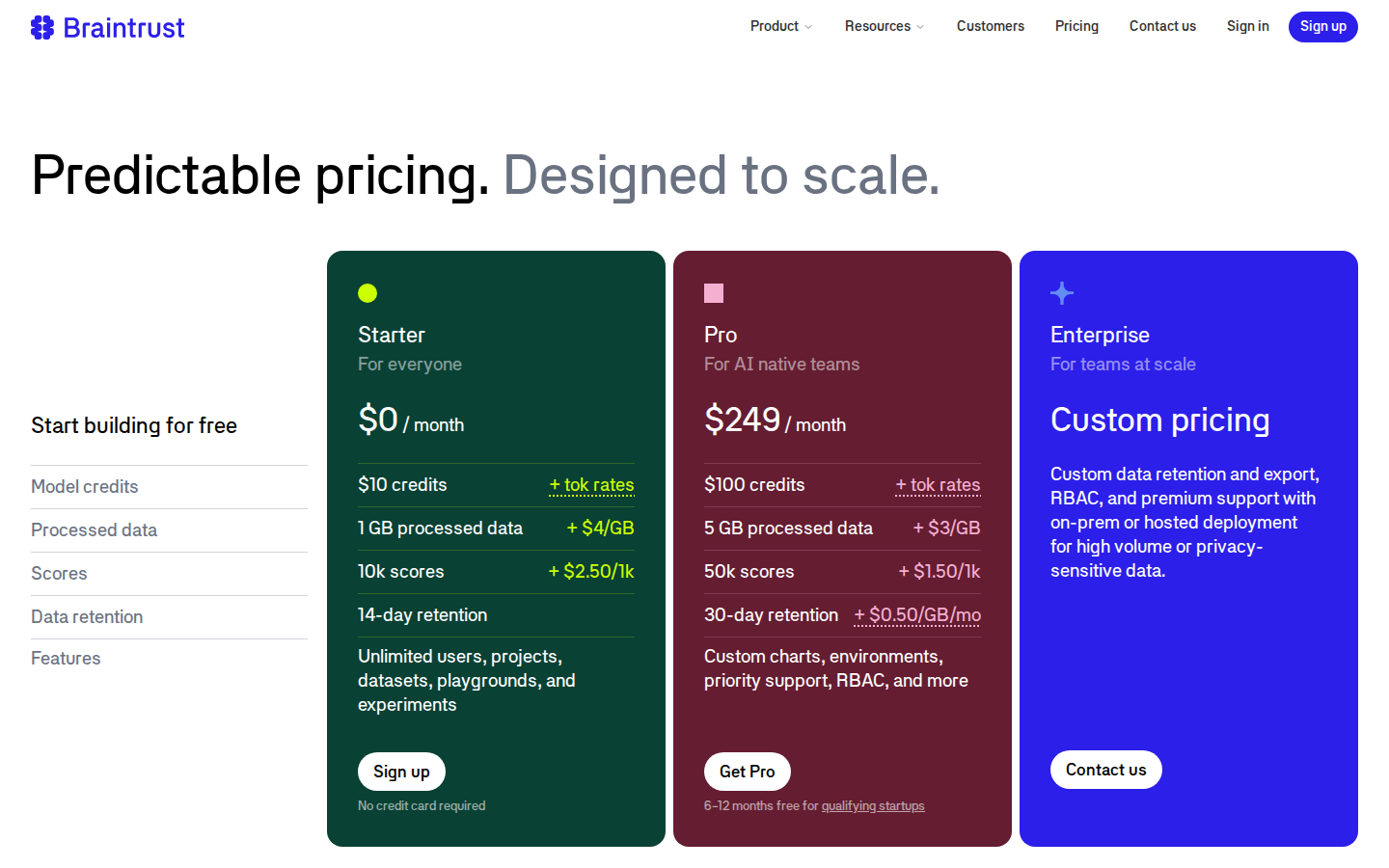
On evidence day the pricing page lists three tiers (platform fee only, usage billed separately): Starter $0 ($10 model credits, 1GB processed + $4/GB, 10K scores + $2.50/1k, 14-day retention, 1 human-review score per project); Pro $249/mo ($100 credits, 5GB + $3/GB, 50K scores + $1.50/1k, 30-day retention then $0.50/GB/mo, plus Loop agent, RBAC, environments, custom charts); Enterprise custom (BYOC/self-hosted, custom retention, S3 export). (Sources 2/36) Fact What all three share is stated bluntly: users / projects / playgrounds / experiments / datasets are all Unlimited, with 6–12 free months for qualifying startups. (Source 2) Fact — headcount is not metered; the money is collected on data volume and score counts. (Source 2) Inference
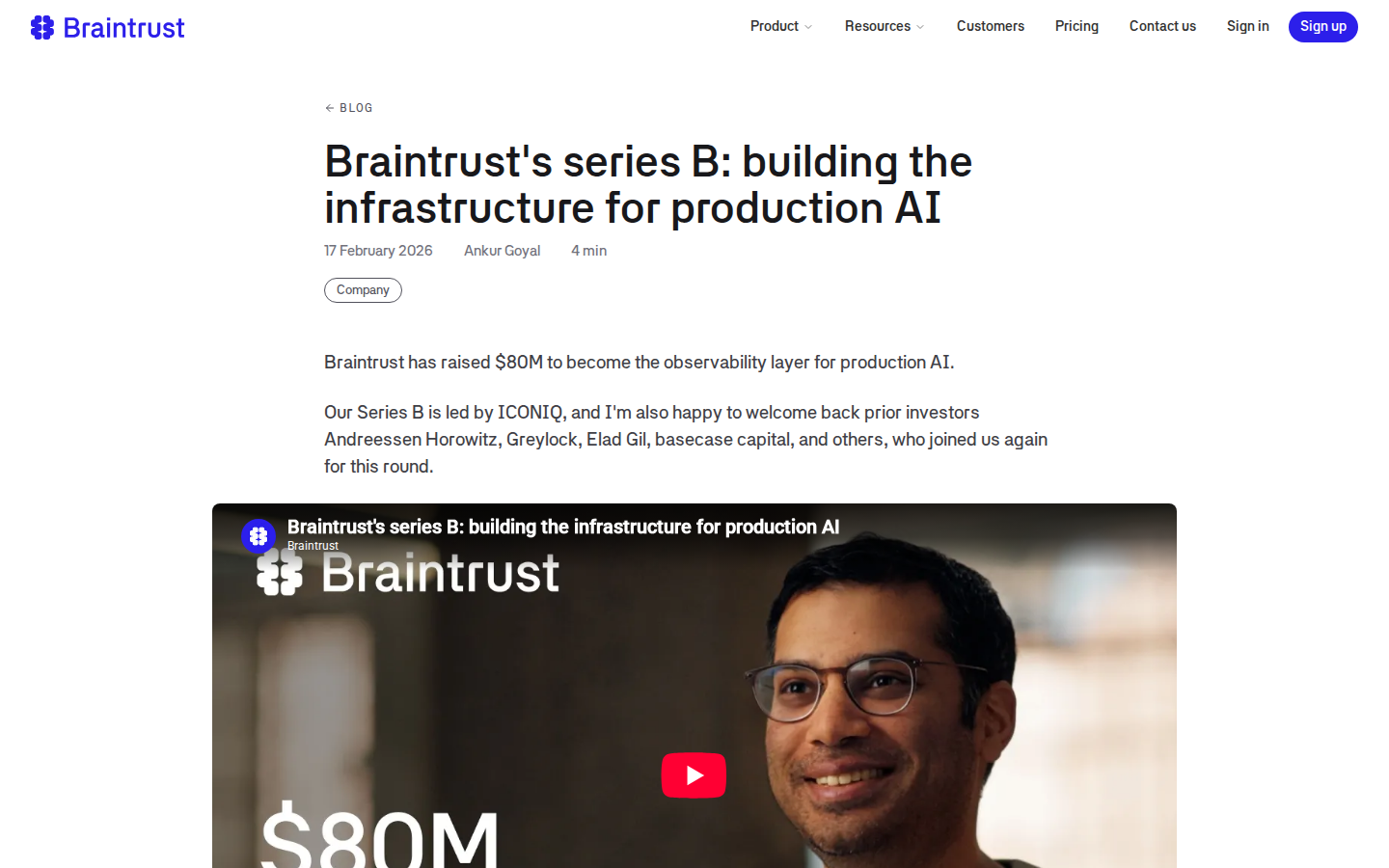
The funding history has four segments, each with its own source and never strung together: 2023-09 TechCrunch reports $3M for the four-person company. (Source 8) Fact; 2023-12 seed of $5.1M led by Greylock (Wikipedia's citation line). (Source 7) Fact; 2024-10-08 Series A $36M led by a16z (Martin Casado), $45M cumulative, with Greg Brockman, Arthur Mensch, Datadog and Databricks Ventures on the list, plus a third-party $150M post-money from finsmes. (Sources 4/9) 【Fact/存疑】; 2026-02-17 Series B $80M led by ICONIQ with a16z/Greylock/Elad Gil returning, the official post never states a valuation, while $800M comes from SiliconANGLE and other third parties. (Sources 3/11) 【Fact/存疑】 Cumulative funding of $125M is this article adding $45M + $80M; no official figure exists. (Sources 4/3) Inference
The customer list upgraded in step: the Series A post names Notion, Stripe, Vercel, Airtable, Instacart, Zapier, Coda, The Browser Company; the Series B post switches to Notion, Replit, Cloudflare, Ramp, Dropbox. (Sources 4/3) Fact The Notion case page carries the hardest efficiency number on the site: 70 engineers aligned on evals and shipped a new frontier-model deployment within 24 hours (signed Sarah Sachs, AI Modeling Lead). (Source 6) Fact On revenue there is no official figure at all; third-party estimates are deliberately not citedDoubtful.
Caliber reconciliation: one company, downloads counted by one book and stars by another
- Downloads vs stars (the core pair): npm month 6,889,964 + PyPI month 6,574,708 vs JS SDK main repo 29 stars, Python SDK repo 22 stars (Sources 22/26/20/17)
- npm and PyPI "months" are different windows: npm's point API is a fixed window 2026-09-19→10-18, pypistats is a rolling 30 days, so the sum only reaches an order-of-magnitude "≈13.46M/month", not an exact same-window figure (Source 22/26) Inference
- Integration count: official tab
All (88)= 26+50+11+1, matching the page-by-pagellms.txtaudit — this time the two calibers agree (Source 33) - Two valuations: $150M post (2024-10, third party finsmes) and $800M (2026-02, third party SiliconANGLE); neither official financing post states a valuation (Sources 9/11/3/4)
- Cumulative funding: the official line stops at "total funding to $45 million" (2024-10); adding the $80M Series B to reach $125M is this article's arithmetic (Sources 4/3) Inference
- Benchmark: the 23.9× numbers compare against "a leading competitor", never named in the text (Source 29) Doubtful
- Docs domain:
docs.braintrust.devwas unreachable on evidence day through both channels (530/1016); the canonical docs live atwww.braintrust.dev/docs— always cite with www (measured on evidence day) Fact
Risks and doubts
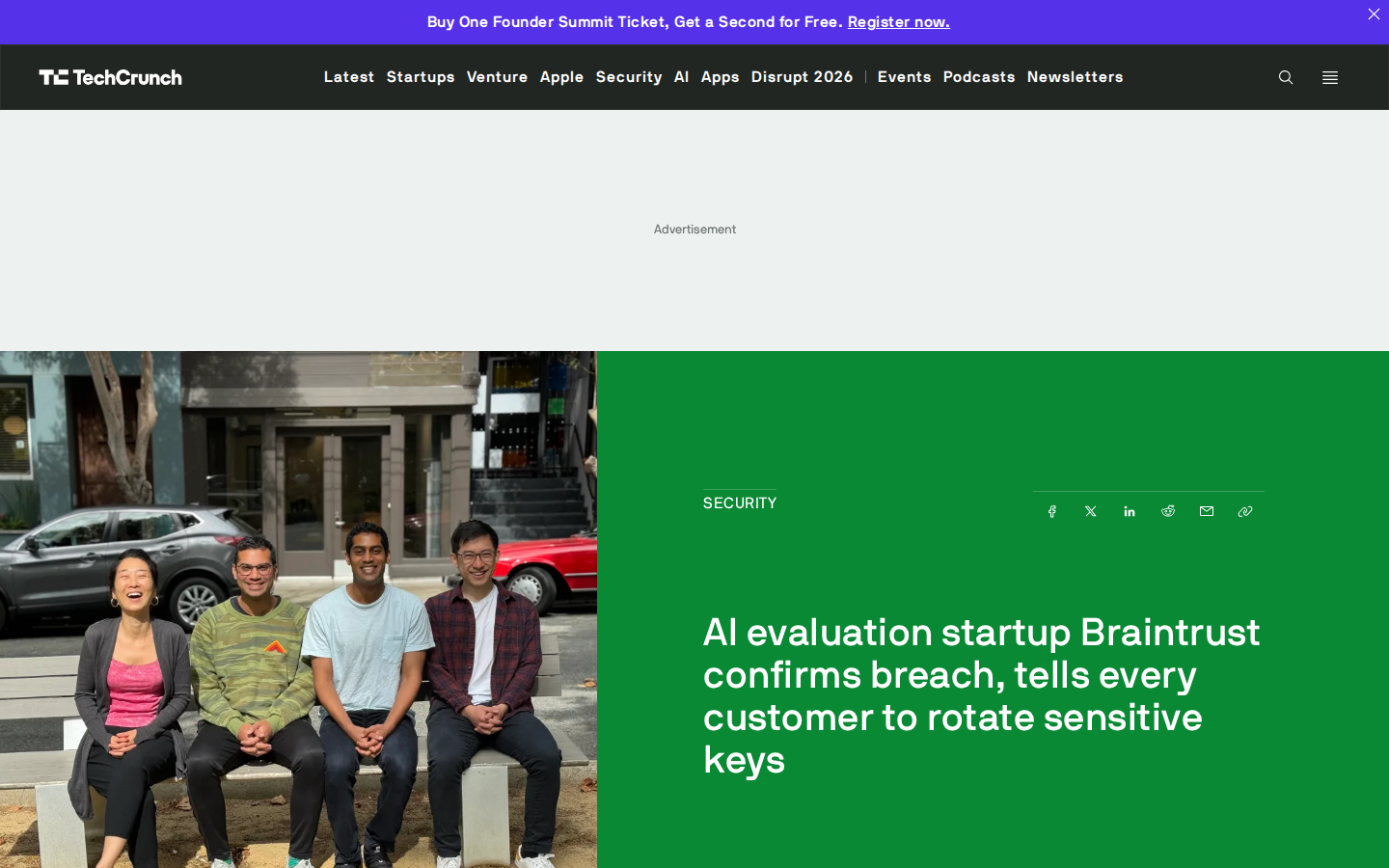
- The quality inspector got breached itself: TechCrunch reported on 2026-05-06 that Braintrust confirmed unauthorized access to one AWS account, and that account held customers' stored model API keys; the email asked "every customer to rotate", while the company said it locked the account, audited related systems and rotated internal secrets, with no broader exposure found so far. (Sources 12/13) Fact — the QA platform had also become a key vault, an attack surface baked into the product shape. (Source 12) Inference
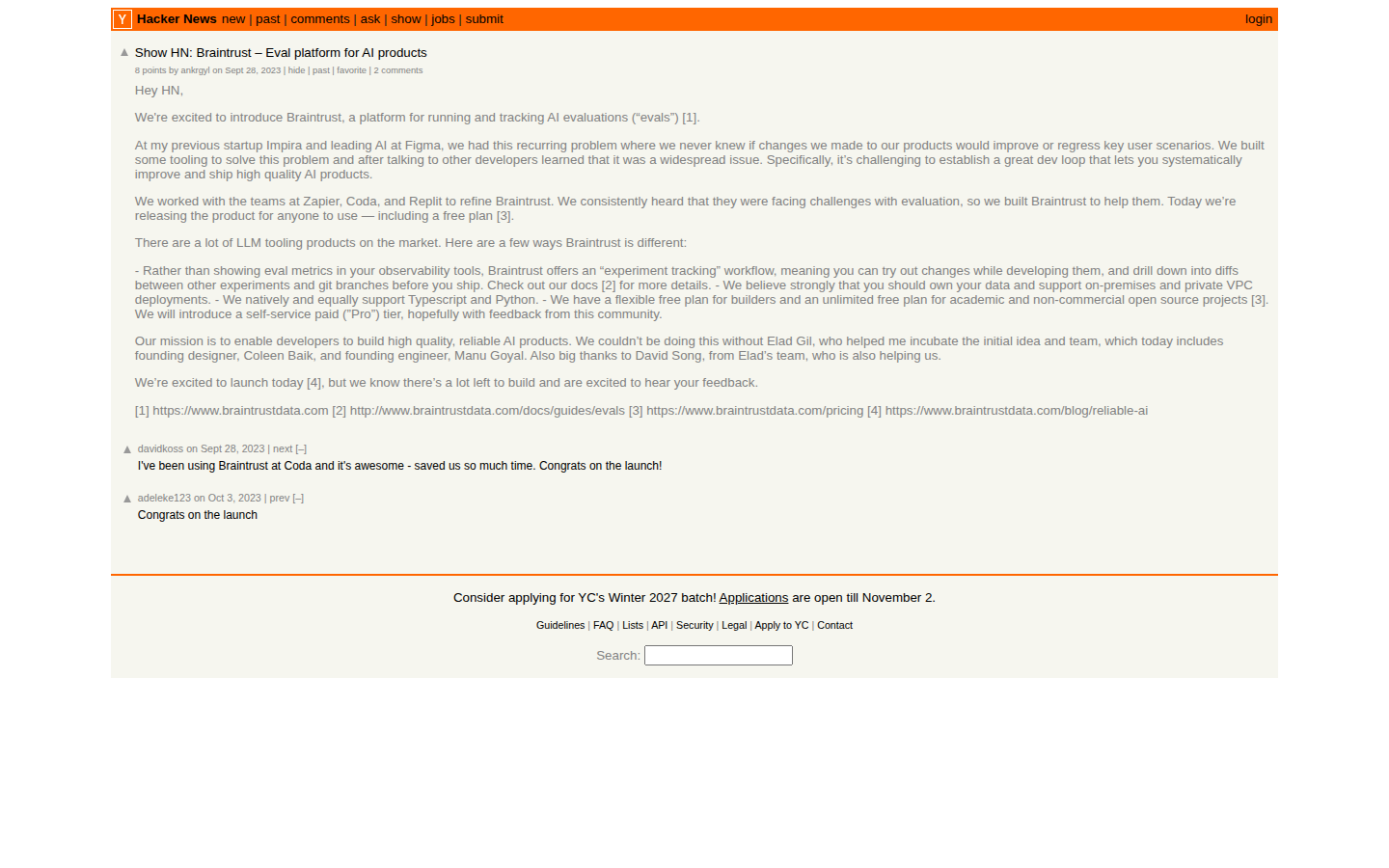
- Community sentiment is not uniformly positive: the 2023-09-28 Show HN launch drew only 8 points / 2 comments (posted by founder ankrgyl). (Source 14) Fact In the 2025-06-05 Ask HN《Everything feels half-baked》a user wrote "Braintrust: Interesting approach to evaluation but feels like an early-stage product. Documentation is sparse and integration options are limited" — a sharp contrast next to 88 integrations and the big-name customer list. (Source 15) Fact
- Valuation and revenue are all third-party: officials stay silent; $800M and $150M post both come from third-party retellings and must be cited with the outlet's name and date. (Sources 9/11) Doubtful
- Proxy double caliber: the deprecation doc and the active repo coexist; quoting only one sentence distorts it. (Sources 19/31) Fact
- Self-run benchmark: Brainstore's comparison names no opponent and was self-tested; before using it for vendor selection, find an independent rerun. (Source 29) Doubtful
- Third-party shootouts get a lower prior: the Langfuse/LangSmith/Braintrust comparison on llmtools.cc (2026-07-26) frames Braintrust as the "eval-first regression workhorse" with a $249/mo starting paid tier — usable as market consensus, but numbers defer to the official site on the day. (Source 37) Doubtful
Conclusion
Fold the stack into one sentence: Braintrust is three concentric rings — the outer ring of 108 open-source repos (MIT/Apache-2.0) handles acquisition and ecosystem position, the middle ring of 13.46M monthly npm+PyPI SDK downloads burrows into your CI, and the inner ring of control-plane/data-plane split plus the homegrown Brainstore collects the money — each ring doing its own job: without autoevals' 1,063 stars it never enters the eval-tool shortlist, without tens of millions of SDK downloads the "88 integrations" story cannot stand, and without the BYOC data plane it cannot sell into enterprises that care about data sovereignty. (Sources 17/22/28/33) Inference
Three stealable moves for tool builders: ①keep downloads and stars in separate ledgers — machine installs prove market share, stars prove community; grabbing the wrong metric makes you decide wrong (Sources 20/22) Opinion; ②write the deprecation script — "deprecated → gateway, I reroute the traffic, you change nothing" drives exit cost to zero, far more graceful than quietly deleting the repo (Source 31) Opinion; ③give the docs two doors, one for humans and one for machines — an llms.txt index of 88 integrations plus per-page Copy page buttons pre-occupies the AI-retrieval distribution slot (Source 33) Opinion.
One sobering dose (for peers, and for this author's team): a company whose business is "grading AI" had to ask every customer to rotate keys in May because it was storing their keys — the closer your capability sits to core assets, the heavier the custody duty; next time you evaluate such a platform, the first question is not how many times the benchmark is faster, but what exactly it is holding of yours. (Source 12) Opinion
Sources (all evidence collected on 2026-10-21, UTC+8; channel A server-side fetch + local DDG cross-search + channel D screenshots ×12 + GitHub PAT read-only API; evidence archive research/evidence/braintrust/, 143 files, manifest with sha256):
- https://www.braintrust.dev/ — homepage above the fold (The active observability platform for agents / Ship quality agents at scale / Observe·Evaluate·Discover / Academy / Encyclopedia)
- https://www.braintrust.dev/pricing — three platform-fee tiers (Starter $0 / Pro $249 / Enterprise Custom), $10/$100 model credits, 1GB+$4/GB, 10K scores+$2.50/1k, 14/30-day retention, Unlimited users·projects·experiments, 6–12 free months
- https://www.braintrust.dev/blog/announcing-series-b — 2026-02-17: $80M, ICONIQ leading, a16z/Greylock/Elad Gil/basecase returning, naming Notion·Replit·Cloudflare·Ramp·Dropbox, self-built database (no valuation anywhere in the post)
- https://www.braintrust.dev/blog/announcing-series-a — 2024-10-08: $36M, a16z (Martin Casado) leading, total $45M, angels incl. Greg Brockman·Arthur Mensch·Guillermo Rauch·Simon Last·Bryan Helmig + Datadog·Databricks Ventures, naming Notion·Stripe·Vercel·Airtable·Instacart·Zapier·Coda·Browser Company
- https://www.braintrust.dev/customers — customer testimonial page (named titles)
- https://www.braintrust.dev/customers/notion — Notion case: 70 Engineers aligned on evals / <24hrs to deploy a new frontier model / signed Sarah Sachs
- https://en.wikipedia.org/wiki/Braintrust — founded 2023-08, Ankur Goyal, Elad Gil incubation, 2023-12 $5.1M seed (Greylock), 2024-10 $36M @$150M, 2026-02 $80M, Trace conference, Brainstore/Loop/Gateway, Notion·Stripe·Airtable
- https://techcrunch.com/2023/09/28/the-newest-new-thing-continuous-feedback-platforms-that-keep-bad-results-from-ai-created-code-from-making-it-into-production/ — four-person company, $3M, "operating system for engineers building AI software", Elad Gil/Adam D'Angelo/Clem Delangue
- https://www.finsmes.com/2024/10/braintrust-raises-36m-in-series-a-funding.html — $36M Series A at $150M post-money (third party)
- https://www.finsmes.com/2026/02/braintrust-raises-80m-in-series-b-funding.html — $80M Series B (third-party confirmation of the round)
- https://siliconangle.com/2026/02/17/braintrust-lands-80m-series-b-funding-round-become-observability-layer-ai/ — $800M valuation (third party; absent from the official post)
- https://techcrunch.com/2026/05/06/ai-evaluation-startup-braintrust-confirms-breach-tells-every-customer-to-rotate-sensitive-keys/ — AWS account unauthorized access, customer model API keys, "every customer to rotate", containment wording
- https://tech.yahoo.com/cybersecurity/articles/ai-evaluation-startup-braintrust-confirms-180541225.html — syndicated copy of the same report (cross-check)
- https://news.ycombinator.com/item?id=37692239 — Show HN 2023-09-28, 8 points / 2 comments, author ankrgyl
- https://news.ycombinator.com/item?id=44194187 — Ask HN 2025-06-05, "feels like an early-stage product. Documentation is sparse"
- https://hn.algolia.com/api/v1/search?query=braintrust&tags=story — full HN search (the brand's threads generally score single to low double digits)
- https://api.github.com/search/repositories?q=org:braintrustdata&sort=stars&per_page=15 — 78 non-fork repos, star ranking (from autoevals 1,063 down)
- https://api.github.com/repos/braintrustdata/autoevals — 1,063 stars / 91 forks / 45 issues / MIT / created 2023-07-11 / pushed 2026-10-08
- https://api.github.com/repos/braintrustdata/braintrust-proxy — 412 stars / 119 issues / MIT / created 2023-11-22 / pushed 2026-10-20
- https://api.github.com/repos/braintrustdata/braintrust-sdk-javascript — 29 stars / 74 issues / Apache-2.0 / created 2023-07-17 / pushed 2026-10-20
- https://api.github.com/orgs/braintrustdata/repos?per_page=100 (two paginated pages, PAT read-only) — 108 repos / 78 non-fork / 2,365 stars / language spread / created 2023-07-10 → 2026-07-30
- https://api.npmjs.org/downloads/point/last-month/braintrust — 6,889,964 (2026-09-19 → 2026-10-18)
- https://api.npmjs.org/downloads/range/2025-10-01:2026-10-20/braintrust — 385-day total 44,242,439; monthly 2026-03 2,836,340 → 2026-09 7,104,136
- https://api.npmjs.org/downloads/point/last-month/autoevals — 2,438,756 (2026-09-19 → 2026-10-18)
- https://registry.npmjs.org/braintrust — created 2023-07-09 (0.0.1), latest 3.38.0 (2026-10-19), MIT, repository → braintrust-sdk-javascript
- https://pypistats.org/api/packages/braintrust/recent — last_month 6,574,708 / last_week 1,769,701 / last_day 298,474
- https://pypi.org/pypi/braintrust/json — version 0.47.0, source → braintrust-sdk-python
- https://www.braintrust.dev/docs/admin/self-hosting/architecture — control-plane/data-plane split, data-plane components (API service/PostgreSQL/Redis/object storage/Brainstore), SDKs talk to your data plane directly
- https://www.braintrust.dev/blog/brainstore-benchmarks — 3.9M traces, 23.9× (9,587→401ms), 2.55× (17,775→6,984ms), 3.73× (1,290→346ms), opponent "a leading competitor" unnamed
- https://www.braintrust.dev/blog/brainstore — Brainstore announcement (object storage + streaming Rust engine rationale)
- https://www.braintrust.dev/docs/deploy/ai-proxy — "The AI proxy is deprecated and will no longer be regularly maintained. Use the gateway instead" + silent routing of v1/proxy to the gateway
- https://raw.githubusercontent.com/braintrustdata/braintrust-proxy/main/README.md — unified API / automatic caching / observability "Coming soon" original promise
- https://www.braintrust.dev/docs/integrations — official count All (88) = providers 26 + SDK integrations 50 + developer tools 11 (+ runtime 1 via llms.txt page-by-page)
- https://www.braintrust.dev/docs/changelog — monthly changelog (nav reaching back to 2023-06), October 2026 entries (Patterns severity / PagerDuty / coding agent insights / SQL charts / Loop / trace cursor sessions, data plane v2.x gating)
- https://www.braintrust.dev/docs/security — SOC 2 Type II / HIPAA / GDPR / Trust center / deployment options
- https://www.braintrust.dev/docs/plans-and-limits — cross-check of the three tiers' limits (Starter $0 / Pro $249 / Enterprise, retention and quotas)
- https://llmtools.cc/blog/langfuse-vs-langsmith-vs-braintrust/ — third-party positioning (Langfuse open-source default / LangSmith LangChain suite / Braintrust eval-first, $249/mo starting paid tier, 2026-07-26)
- https://github.com/braintrustdata/lingua — Rust format-translation library (LLM message format, 28 stars, created 2025-08-30)
- https://www.braintrust.dev/docs/integrations/agent-frameworks/pi-coding-agent — official integration page "Pi Coding Agent SDK / Trace Pi Coding Agent SDK prompts"
Errata: any error in this article can be reported via javis.im comments and will be corrected after verification; if a conclusion is overturned, this article will be marked withdrawn. The Fact/Inference/Opinion/Doubtful color tags are the credibility tiers — readers may rely on the Fact part alone. The conflict of interest is disclosed at the top; the two seed calibers ($3M vs $5.1M), the two third-party valuations ($150M vs $800M), the $125M cumulative sum, the differing npm/PyPI monthly windows, Brainstore's self-run benchmark with unnamed opponent, the proxy deprecated-vs-active double caliber, and the dead docs subdomain vs the canonical www host are all printed alongside the article rather than smoothed away.